
| Core Fact | Thiruvananthapuram District Details |
|---|---|
| Geographical Location / Status | Southernmost district of Keralam; state capital district; located on Keralam’s south-western coast. It borders the Arabian Sea and Tamil Nadu. |
| District Headquarters | Thiruvananthapuram |
| Total Land Area in sq km | 2,192 sq km |
| Population as per latest available Census data | 3,307,284 as per 2011 Census data listed by the district administration |
| Literacy Rate | 93.02% |
| Number of Rivers / Major Rivers | Exact official district river count is not clearly available from official public sources. Major rivers include Neyyar, Karamana, and Vamanapuram. |
| Revenue Divisions | 2 — Thiruvananthapuram and Nedumangadu |
| Taluks | 6 — Thiruvananthapuram, Nedumangadu, Chirayinkeezhu, Kattakada, Neyyattinkara, Varkala |
| Municipalities | 4 — Attingal, Nedumangad, Neyyattinkara, Varkala |
| Number of Grama Panchayats | 73 |
| Assembly Constituencies | 14 — Varkala, Attingal, Chirayinkeezhu, Nedumangad, Vamanapuram, Kazhakkoottam, Vattiyoorkavu, Thiruvananthapuram, Nemom, Aruvikkara, Parassala, Kattakkada, Kovalam, Neyyattinkara |
| Lok Sabha Constituency / Constituencies | Thiruvananthapuram and Attingal |
| Official District Website | Official District Administration Website — District Thiruvananthapuram, Government of Keralam |
What Makes Thiruvananthapuram Unique?
Thiruvananthapuram district is Keralam’s capital district. Thiruvananthapuram city is both the district headquarters and the State capital. The district administration also identifies it as Keralam’s southernmost district.
Thiruvananthapuram Keralam has a rare mix of state administration, coastal geography, heritage, science, education, tourism, and IT. The Keralam Secretariat, District Collectorate, major government departments, courts, public institutions, universities, hospitals, and transport hubs are concentrated here.
The district has strong historical links with the former Travancore state. The name Thiruvananthapuram is connected with Sree Padmanabhaswamy Temple and Anantha Padmanabha. The official district page describes the city name as connected with Lord Vishnu reclining on Anantha.
Malayalam is the main language of the district. The district administration lists Malayalam as the district language. English is widely used in government, education, tourism, IT, and public services. Tamil is also heard in areas near the Tamil Nadu border.
Thiruvananthapuram district has a long Arabian Sea coastline. The district administration lists a coastal stretch of 78 km. This gives the district strong coastal, fishing, tourism, and port importance.
The district is also important for research and technology. It hosts major institutions such as Vikram Sarabhai Space Centre, Indian Institute of Space Science and Technology, Indian Institute of Science Education and Research, University of Keralam, and Technopark. The official district site lists VSSC among key district landmarks, and official institutional sources identify IIST and IISER Thiruvananthapuram as major national-level education and research institutions.
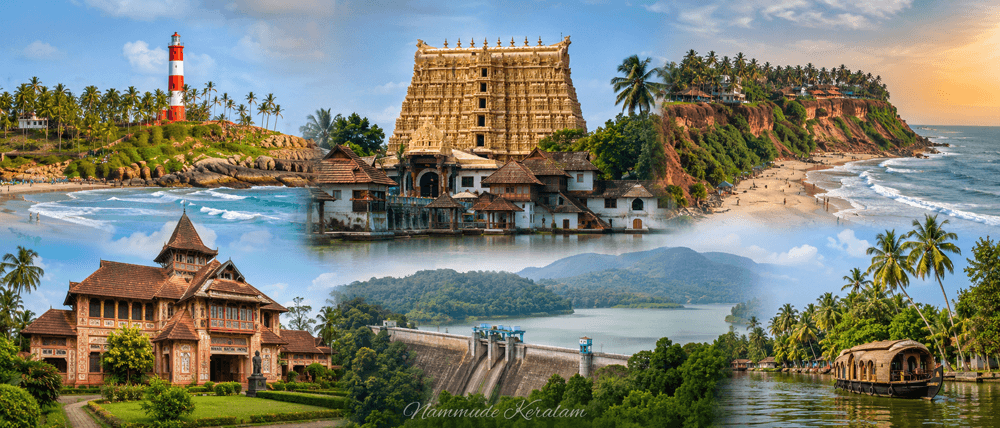
Culturally, the district is known for temple festivals, classical music traditions, Travancore heritage, museums, coastal settlements, and public festivals. Keralam Tourism highlights Sree Padmanabhaswamy Temple, Kuthira Malika Palace, Napier Museum, Kovalam, Varkala, Neyyar Wildlife Sanctuary, Peppara Wildlife Sanctuary, and Attukal Pongala as important cultural and tourism anchors.
Geography and Administrative Profile
Location in Keralam
Thiruvananthapuram district is located at the southern end of Keralam. It lies on the west coast of India near the extreme south of the mainland.
The district stretches along the Arabian Sea coast. It also reaches into the Western Ghats on the eastern side. Keralam Tourism describes the district as having the Arabian Sea to the west and Tamil Nadu to the east.
Boundaries
Thiruvananthapuram district shares boundaries with:
North: Kollam district
East: Tirunelveli district, Tamil Nadu
South: Kanyakumari district, Tamil Nadu
West: Arabian Sea
These boundaries are listed by the district administration.
Terrain and Natural Features
The district includes coastal plains, urban areas, low coastal hills, river valleys, forested highlands, and Western Ghats landscapes. The district administration describes the city’s terrain as low coastal hills. Keralam Tourism also identifies beaches, wildlife areas, hills, and backwaters as major district features.
Important natural and landscape features include:
Arabian Sea coast
Neyyar reservoir and Neyyar Wildlife Sanctuary
Peppara Wildlife Sanctuary
Varkala cliffs and beach
Kovalam beach zone
Poovar estuary and backwater landscape
Veli Lake and coastal backwater area
Western Ghats highlands near Vithura, Ponmudi, and adjoining forest regions
Revenue Divisions
Thiruvananthapuram district has 2 revenue divisions:
Thiruvananthapuram
Nedumangadu
Each revenue division is headed by a Revenue Divisional Officer or Sub Collector.
Thiruvananthapuram Taluks
Thiruvananthapuram taluks are:
Thiruvananthapuram
Nedumangadu
Chirayinkeezhu
Kattakada
Neyyattinkara
Varkala
The official district site lists 6 taluks.
Municipalities and Urban Bodies
Thiruvananthapuram municipalities are:
Attingal Municipality
Nedumangad Municipality
Neyyattinkara Municipality
Varkala Municipality
The district also has Thiruvananthapuram Municipal Corporation. The official local self-government listing shows 4 municipalities and 1 corporation.
Panchayat Structure
The district has:
1 District Panchayat
11 Block Panchayats
73 Grama Panchayats
4 Municipalities
1 Municipal Corporation
The official district local self-government page lists the district panchayat, block panchayats, municipalities, corporation, and 73 grama panchayats.
Major Towns and Urban Centers
Major towns and urban centers include:
Thiruvananthapuram city
Neyyattinkara
Nedumangad
Attingal
Varkala
Kazhakkoottam
Kovalam
Vizhinjam
Kattakada
Chirayinkeezhu
The district administration lists Thiruvananthapuram city, Neyyattinkara, Nedumangad, Attingal, and Varkala as main towns. Kazhakkoottam, Kovalam, Vizhinjam, Kattakada, and Chirayinkeezhu are also important local centers due to transport, tourism, port, administrative, and constituency relevance.
Major Places to Know in Thiruvananthapuram
Sree Padmanabhaswamy Temple
Location: East Fort, Thiruvananthapuram city.
Why it is important: It is one of the most important religious and heritage landmarks in Thiruvananthapuram district.
Claim to fame: The city name Thiruvananthapuram is connected with Anantha Padmanabha, the deity associated with the temple.
Sree Padmanabhaswamy Temple is a central landmark in the capital city. Keralam Tourism describes it as a major historical and spiritual landmark of Thiruvananthapuram.
Kovalam Beach
Location: Kovalam, south of Thiruvananthapuram city.
Why it is important: Kovalam is one of the best-known beach areas in Thiruvananthapuram tourist places.
Claim to fame: Keralam Tourism describes Kovalam as one of Thiruvananthapuram’s most renowned beaches.
Kovalam is known for its beach landscape and lighthouse area. It is closely connected with tourism, hospitality, local livelihoods, and coastal travel in Thiruvananthapuram Keralam.
Varkala Beach
Location: Varkala, northern coastal part of Thiruvananthapuram district.
Why it is important: Varkala is a major coastal town and municipality in the district.
Claim to fame: Keralam Tourism highlights Varkala Beach for its cliffside setting overlooking the Arabian Sea.
Varkala combines beach tourism, coastal settlement, religious activity, and local commerce. It also anchors the Varkala taluk and Varkala Assembly constituency.
Neyyar Wildlife Sanctuary
Location: Near Neyyar Dam, eastern Thiruvananthapuram district.
Why it is important: It is one of the district’s key forest and wildlife destinations.
Claim to fame: Keralam Tourism states that Neyyar Wildlife Sanctuary is part of the Agasthyamala Biosphere Reserve and covers about 128 sq km.
Neyyar Wildlife Sanctuary links the district with the Western Ghats landscape. It is important for conservation, tourism, water resources, and environmental education.
Napier Museum
Location: Museum compound, Thiruvananthapuram city.
Why it is important: It is a major museum and cultural landmark in the capital city.
Claim to fame: Keralam Tourism identifies Napier Museum as an important institution showcasing Keralam’s cultural evolution.
Napier Museum is part of the city’s heritage and education circuit. It is useful for students, tourists, researchers, and visitors interested in Keralam history and art.
Citizen Services and Local Infrastructure in Thiruvananthapuram
Administrative Centers
Thiruvananthapuram district administration is centered in the capital district. Important administrative centers include:
District Collectorate, Thiruvananthapuram
Civil Station, Kudappanakunnu
Revenue Divisional Office, Thiruvananthapuram
Revenue Divisional Office, Nedumangadu
Taluk offices in Thiruvananthapuram, Nedumangadu, Chirayinkeezhu, Kattakada, Neyyattinkara, and Varkala
Thiruvananthapuram Municipal Corporation
Attingal, Nedumangad, Neyyattinkara, and Varkala Municipalities
District Panchayat and Block Panchayat offices
Thiruvananthapuram City Police and Thiruvananthapuram Rural Police offices
District courts and subordinate courts
The official district site lists Collectorate, revenue divisions, taluks, urban bodies, panchayats, courts, and police sections under its administrative setup.
Health Infrastructure
Thiruvananthapuram citizen services depend heavily on its public health network. Major public health institutions include:
Government Medical College Hospital, Thiruvananthapuram
General Hospital, Thiruvananthapuram
General Hospital, Neyyattinkara
Women and Children’s Hospital, Thycaud
SAT Hospital, Thiruvananthapuram
Regional Cancer Centre, Thiruvananthapuram
Sree Chitra Tirunal Institute for Medical Sciences and Technology
Taluk and community-level public health institutions
Government Medical College, Thiruvananthapuram was founded in 1951 and is described by its official site as Keralam’s oldest medical institution. The State Health Agency’s public hospital list includes Government Medical College Hospital TVM, General Hospital Thiruvananthapuram, and General Hospital Neyyattinkara.
Education Infrastructure
Thiruvananthapuram district is one of Keralam’s major education and research centers. Important institutions include:
University of Keralam
APJ Abdul Kalam Technological University
Indian Institute of Space Science and Technology
Indian Institute of Science Education and Research Thiruvananthapuram
College of Engineering Trivandrum
Government Arts College, Thiruvananthapuram
Government Law College, Thiruvananthapuram
Government Medical College, Thiruvananthapuram
Sree Chitra Tirunal Institute for Medical Sciences and Technology
National Institute for Interdisciplinary Science and Technology
Vikram Sarabhai Space Centre
The district administration lists universities and institutions under public utilities. It includes IISER Thiruvananthapuram and Indian Institute of Space Science and Technology. IIST identifies itself as a space science and technology institution located at Valiamala, Thiruvananthapuram.
Transport Infrastructure
Thiruvananthapuram has strong road, rail, air, and port connectivity.
Important transport points include:
Thiruvananthapuram Central Railway Station
Kochuveli Railway Station
Kazhakkoottam Railway Station
Thiruvananthapuram International Airport
Thampanoor Central Bus Station
East Fort city bus hub
Kazhakkoottam bus and IT corridor connectivity
National Highway 66 coastal corridor
Major state highways connecting Nedumangad, Ponmudi, Neyyattinkara, Kattakada, Varkala, and adjoining regions
Vizhinjam International Seaport
The district transport section lists Thiruvananthapuram Central Railway Station under rail transport. Technopark’s official travel page lists Thiruvananthapuram International Airport, Kochuveli, Thiruvananthapuram Central, Kazhakkoottam railway access, and Kazhakkoottam bus station as key connectivity points.
Vizhinjam International Seaport is a major coastal infrastructure project in Thiruvananthapuram district. The official district site displays Vizhinjam International Sea Port among district landmarks.
Economy and Local Livelihoods
Thiruvananthapuram district has a mixed economy. It combines government services, IT, education, tourism, fisheries, small trade, agriculture, public sector activity, healthcare, and research.
Government and Service Sector
As Keralam’s capital district, government employment is a major economic base. The Keralam Secretariat, directorates, public sector offices, courts, police offices, educational departments, and district administration create a large service economy.
The district also has strong healthcare, education, legal, media, hospitality, and transport services. These sectors support both local citizens and visitors.
Information Technology and Research
Technopark is one of the strongest economic anchors of Thiruvananthapuram Keralam. Its official site describes it as India’s first IT park and a major technology park in Keralam.
The district also has major research and science institutions. VSSC, IIST, IISER, SCTIMST, RGCB, NIIST, and other institutions shape the district’s knowledge economy.
Tourism and Hospitality
Tourism is important in coastal, urban, cultural, and hill areas. Kovalam, Varkala, Sree Padmanabhaswamy Temple, Napier Museum, Neyyar, Poovar, Veli, Ponmudi, and Peppara attract different visitor groups.
Tourism supports hotels, restaurants, transport operators, guides, artisans, small shops, beach services, and local travel networks.
Fisheries and Coastal Livelihoods
The 78 km coastline supports fishing communities, fish markets, boat-related livelihoods, seafood trade, and coastal transport activity. Vizhinjam, Poovar, Anchuthengu, Varkala coastal belt, Kovalam, and adjoining coastal areas are important in the district’s coastal economy.
Agriculture and Rural Livelihoods
Agriculture remains important in rural panchayat areas. Coconut, banana, vegetables, tapioca, rubber, spices, and mixed homestead farming are seen across rural parts. Hill and midland areas near Nedumangad, Vithura, Palode, Kattakada, and adjoining regions support agriculture, forest-linked livelihoods, and local trade.
Port and Trade Potential
Vizhinjam International Seaport gives the district long-term logistics and maritime importance. It is expected to shape future cargo, trade, transport, warehousing, and port-linked services in the district.
Culture, Language, and Society
Malayalam is the main language of Thiruvananthapuram district. The official district profile lists Malayalam as the district language. English is common in education, government, tourism, and IT. Tamil is also spoken in border and migrant communities.
The district’s cultural identity is strongly linked with Travancore history, temple traditions, coastal communities, public institutions, and state-capital life. Sree Padmanabhaswamy Temple, Attukal Bhagavathy Temple, Kuthira Malika, Napier Museum, and the public museum-zoo complex are important heritage anchors.
Major festivals and cultural events include:
Onam
Attukal Pongala
Sree Padmanabhaswamy Temple festivals
Christmas celebrations
Eid observances
Local church feasts
Mosque festivals and community observances
Temple utsavams across rural and urban areas
Keralam Tourism identifies Attukal Pongala as one of the district’s major festival events and notes its large women-led gathering.
Traditional art and performance forms seen in the district include classical music, Kathakali, temple arts, folk performance traditions, devotional music, percussion ensembles, and modern theatre. The district also has a strong public reading, cinema, education, journalism, and civic discussion culture.
Food habits reflect coastal, Travancore, urban, and rural Keralam patterns. Rice, fish curry, coconut-based dishes, tapioca, puttu, appam, idiyappam, dosa, sambar, seafood, banana chips, payasam, and sadya meals are common parts of the food culture.
Thiruvananthapuram Local Information Summary
Thiruvananthapuram district is Keralam’s capital district and southernmost district. It has 2 revenue divisions, 6 taluks, 4 municipalities, 1 corporation, 73 grama panchayats, and 14 Assembly constituencies.
For citizens, Thiruvananthapuram district administration is important for revenue services, certificates, land records, police services, courts, health, education, local self-government, transport, disaster management, and public utilities.
For tourists, Thiruvananthapuram tourist places include Sree Padmanabhaswamy Temple, Kovalam, Varkala, Neyyar Wildlife Sanctuary, Napier Museum, Poovar, Veli, Peppara, and Ponmudi.
For students and researchers, the district is important because of its universities, research institutions, museums, archives, scientific institutions, and public administration role.
Suggested Official Sources to Verify
Official District Administration Website
Keralam Government Portal
Keralam Tourism
Census of India
Local Self Government Department, Keralam
Keralam Legislative Assembly
Election Commission of India
Keralam State Health Agency
University of Keralam
Technopark
Indian Institute of Space Science and Technology
Indian Institute of Science Education and Research Thiruvananthapuram
Frequently Asked Questions About Thiruvananthapuram
What are the taluks in Thiruvananthapuram district?
The taluks in Thiruvananthapuram district are Thiruvananthapuram, Nedumangadu, Chirayinkeezhu, Kattakada, Neyyattinkara, and Varkala. The official district administration lists 6 taluks in Thiruvananthapuram district.
What is Thiruvananthapuram district famous for?
Thiruvananthapuram district is famous as Keralam’s capital district, the southernmost district of Keralam, and a major center for government administration, Sree Padmanabhaswamy Temple, Kovalam and Varkala beaches, Technopark, space research institutions, museums, wildlife sanctuaries, and coastal tourism.
Which are the major tourist places in Thiruvananthapuram?
Major tourist places in Thiruvananthapuram include Sree Padmanabhaswamy Temple, Kovalam Beach, Varkala Beach, Napier Museum, Neyyar Wildlife Sanctuary, Peppara Wildlife Sanctuary, Poovar, Veli Tourist Village, Kuthira Malika Palace, and Ponmudi. Keralam Tourism identifies the district with beaches, wildlife, hills, backwaters, heritage sites, and cultural festivals.